FLS reinforces lifecycle strategy for African mining follow Electra Mining Africa
FLS says discussions at Electra Mining Africa confirmed that African mining companies are increasingly prioritising lifecycle partnerships, plant optimisation and modernisation over major capital projects as they seek to improve productivity and extend the life of existing assets
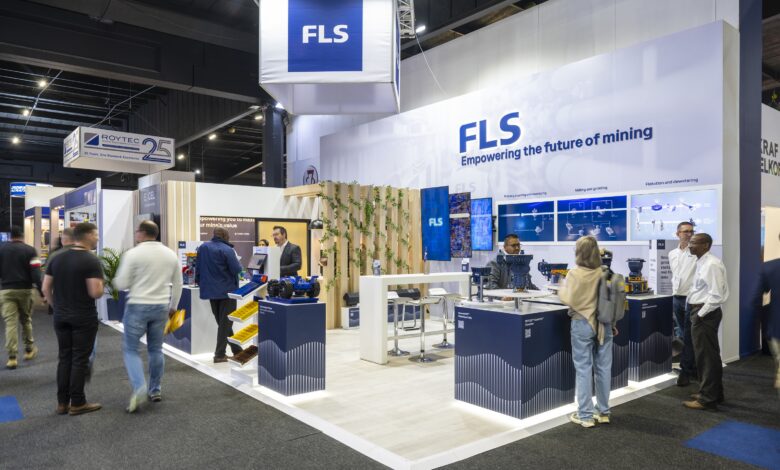
The conversations at Electra Mining Africa highlighted a clear shift taking place across the continent’s mining industry. Faced with ageing processing infrastructure, constrained capital budgets and growing pressure to improve productivity, reliability and sustainability, mining companies are increasingly focused on extracting greater value from existing assets rather than investing in major greenfield developments.
For FLS, these priorities reinforce its evolution from an equipment supplier into a long-term lifecycle partner, combining full flowsheet expertise with regional service capability, optimisation solutions and local technical support to help customers improve plant performance throughout the life of mine.
According to Bernard Kaninda, President of Sales and Services for Africa at FLS, discussions with customers at Electra Mining Africa confirmed that operational improvement has become a higher priority than large capital projects.
“Many operations are looking to increase throughput, improve recovery and extend plant life without committing to significant capital expenditure,” Kaninda says. “That places greater emphasis on service-led interventions such as process optimisation, audits, upgrades, retrofits and lifecycle support that allow customers to unlock additional value from assets already in operation.”
He says this represents a fundamental evolution in how FLS works with its customers. “Our objective is to become a long-term lifecycle partner rather than simply an equipment supplier. We work
alongside customers throughout the life of mine to improve plant performance, minimise downtime and reduce operating costs while supporting their long-term production objectives.”
This approach is particularly relevant across Africa where ageing installed equipment, constrained investment budgets and increasingly complex orebodies require more sophisticated operational support than traditional maintenance contracts.
According to Alistair McKay, Vice President Capital Sales, Europe, Arabia and Africa, Africa’s exceptional geological diversity also demands a different approach to mineral processing.
“The continent encompasses Copperbelt copper-cobalt operations, West African gold, South African platinum group metals, iron ore and numerous other commodities, each presenting unique processing challenges,” McKay says. “Supporting this diversity requires far more than individual products. It requires the ability to engineer and optimise complete mineral processing flowsheets tailored to each orebody and operating environment.”
He explains that the challenge extends well beyond metallurgy. “Many African mines operate in remote locations where long supply chains, customs delays and logistical constraints mean equipment reliability becomes inseparable from service capability. Maintaining operational continuity requires local technical support, regional parts availability and lifecycle partnerships that minimise production interruptions.”
As operators seek to improve performance without replacing entire processing circuits, modernisation has become an increasingly important part of that strategy.
“Many mines are extending the operating life of existing assets through rebuilds, retrofits and targeted upgrades,” Kaninda adds. “These solutions often deliver significant improvements in throughput, energy efficiency and reliability while requiring substantially lower capital investment than complete equipment replacement.”
Asset optimisation is also playing an increasingly important role in overcoming the challenges associated with geographically dispersed mining operations.
“Remote condition monitoring, predictive maintenance and digital diagnostics allow customers to identify potential issues before they develop into failures,” he says. “These technologies are particularly valuable at isolated operations where specialist technical resources are not always immediately available.”
Supporting this lifecycle strategy is FLS’s continued investment in regional service capability across Africa. Kaninda says investments such as the expansion of the Chloorkop service centre in South Africa and the establishment of a new service centre in Accra, Ghana, are designed to bring engineering expertise, repairs, spare parts and technical support closer to mining operations.
“Reducing downtime is not simply about responding quickly when equipment fails,” he says. “It is about ensuring customers have immediate access to skilled technicians, specialist repair capability, critical spare and wear parts and engineering expertise within the region. Local proximity significantly shortens response times and reduces dependence on lengthy overseas supply chains.”
He adds that this strategy is driven by regional teams working directly alongside customers. “Our strategy is built around people on the ground who understand local operating conditions and customer requirements. That local knowledge enables faster decision-making, stronger customer relationships and more effective technical support.”
For Nico Erasmus, Vice President and Head of Pumps, Cyclones and Valves (PCV), Africa, equipment reliability must also be considered within the realities of African mining logistics.
“In many parts of southern and central Africa, uptime depends not only on equipment performance but also on the ability to support that equipment quickly and effectively,” Erasmus says. “A pump or valve failure can stop production for an extended period if replacement parts or repair capability are not readily available. Reliability therefore means resilience across the entire support ecosystem.”
This philosophy underpins the role of the FLS Stormill PCV Service Centre, which provides specialised repair, refurbishment and technical support for pumps, cyclones and valves within the region.
“Having local service capability allows us to restore critical equipment much faster than relying solely on overseas facilities,” he says. “It also creates opportunities to develop local technical expertise and strengthen skills within the African mining industry.”
Erasmus notes that rebuilds and upgrades are becoming increasingly valuable as operators contend with import costs, currency volatility and extended lead times for replacement equipment.
“Rebuilding and upgrading existing equipment often provides a more cost-effective solution than importing new assets, while extending equipment life and maintaining operational performance.”
He adds that resource efficiency has become another important focus area. “In many African mining regions, water availability and energy security have become operational constraints. Improving slurry transport efficiency not only lowers operating costs but also reduces water and energy consumption, delivering measurable productivity and sustainability benefits simultaneously.”
Kaninda says this aligns closely with FLS’s global CORE’26 strategy. “In Africa, sustainability and productivity are closely linked. Improving resource efficiency strengthens both mine economics and operational resilience, particularly in regions facing water scarcity or unreliable power supply.”
McKay concludes that one of the strongest messages emerging from Electra Mining Africa was that mining companies are increasingly looking for integrated, long-term partnerships rather than standalone equipment purchases.
“Africa’s mining industry is focused on extracting greater value from existing operations while building more resilient, efficient and sustainable processing plants,” he says. “Delivering that outcome requires more than supplying equipment. It requires long-term partnerships supported by local expertise, engineering capability and service infrastructure that remain close to our customers throughout the life of their operations.”