Steenkampskraal mine opens Phase 1 of monazite concentrate plant as ministers tour world’s highest-grade rare earth resource
Ministers Mantashe, Ramokgopa and Mgcina join Mintek and the Council for Geoscience in opening Steenkampskraal plant as South Africa moves from laboratory breakthrough to commercial rare earth concentrate production
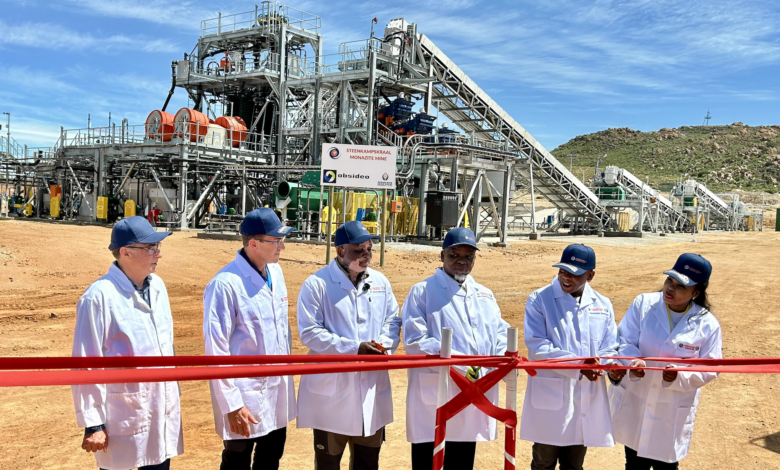
Steenkampskraal Monazite Mine (SMM) has officially opened Phase 1 of the Steenkampskraal project. The opening was done by the Minister of Mineral and Petroleum Resources, Mr Gwede Mantashe, in the presence of the Minister of Electricity and Energy, Dr Kgosientsho Ramokgopa, and Deputy Minister of Mineral and Petroleum Resources, Ms Phumzile Mgcina.
The ministerial visit in the Western Cape included the Chief Executive Officer of Mintek, Dr Molefi Motuku, and Chief Executive Officer of the Council for Geoscience, Mr Mosa Mabuza. The plant opening marks the point at which the world’s highest-grade rare earth deposit moves from laboratory to commercial mineral processing.
Phase 1 crushes and mills ore, then upgrades it by gravity separation and flotation to a monazite concentrate for the export market. SMM says it has secured a number of offtake agreements for its concentrate. First shipments are planned before the end of 2026.
“This is the first commercial step on a road South Africa has already proved it can walk,” said Dr Enock Mathebula, Executive Chairman of Steenkampskraal Monazite Mine. “In June, with Mintek, we produced high-purity mixed rare earth products and became the first African country in achieving this through a partnership between a mine and a national research institution, Mintek. The plant now turns that science into a saleable monazite concentrate. The ministers’ presence tells the market, and our communities, that beneficiation is no longer a slogan at Steenkampskraal. Production is under way.”
In his remarks, Dr Mathebula described rare earths as the ‘vitamins of the economy’ needed in small quantities, but essential to electronics, energy systems, electric vehicles, telecommunications, defence and advanced manufacturing. He said Steenkampskraal’s aim is not to export the resource in raw form, but to process, beneficiate and build manufacturing and skills in South Africa, and that the work with Mintek had made South Africa the first African country to produce mixed rare earth products through a partnership between a mine and a research institution.
He credited the Industrial Development Corporation’s role in funding a project that expands productive capacity, but said the mine cannot reach its full potential without government, science institutions, investors and communities participation resulting in local employment, and skills and local enterprise development.
Minister Mantashe said South Africa must expand its build on robust beneficiation and manufacturing capabilities to add value at the point of production, and that mineral wealth must support industrialisation, jobs and sustainable development. He described Dr Mathebula as one of South Africa’s emerging successful mining entrepreneurs.
Dr Ramokgopa said SMM is regarded as a national strategic asset. “We own it as a country,” he said. “South Africa already has a record of building complex technology, from Sasol to the pebble-bed modular reactor research. We have the scientific resources, and now the opportunity for Steenkampskraal to be a game changer.”
Briefing the ministers, Robbie Louw, Executive Director of SMM, said the resource contains about 14.5 percent total rare earth oxides and about 2.1 percent thorium, the highest-known rare earth grade in the world This is in the order of ten times a typical deposit found worldwide.
“That grade is the economic foundation of Phase 1. Far less rock is required to be mined and processed for each tonne of contained rare earths acquired. Rare earths are hosted in monazite rather than fluoro-carbonates, so concentration is by conventional gravity separation and flotation, developed from the mine’s 1950s flowsheet, refined and optimised in Steenkampskraal’s laboratories, and confirmed by Mintek and other international research organisations. The process to beneficiate the monazite mineral through cracking was also developed in the Steenkampskraal laboratories and has been confirmed by Mintek and further confirmed by the Saskatchewan Research Council,” he said.
Phase 2 of the development will cover monazite cracking into a mixed rare earth product, with thorium recovery. Phase 3 is separation into individual rare earth oxides, using solvent extraction already piloted at Mintek. The June 2026 milestone, a high-purity mixed rare earth product at Mintek’s laboratories, is the technical bridge between Phase 1 concentrate production and the downstream onsite beneficiation.
Energy: a pathway, not yesterday’s product
Louw told the delegation that domestic energy security, and a future energy-fuel pathway, are key to South Africa’s longer-term energy security and Dr Ramokgopa’s attendance. “South Africa needs additional and reliable energy generation that provides baseload and strengthens the grid as wind and solar increase. Steenkampskraal gives the country a strategic indigenous thorium-energy resource, and a pathway to greater fuel-cycle sovereignty.
“The proposal is to use Koeberg to qualify thorium fuel, then deploy it progressively in a new nuclear fleet, including Thyspunt, and to anchor a South African thorium-fuel industry in domestic demand before looking to the export market which will include India and the world’s light-water reactor fleet.”
On technology, Louw said SMM has partnered with Thor Energy, an international thorium-fuel developer, whose oxide fuels have undergone multi-year irradiation testing in the Halden research reactor in Sweden.
On scale, he said Steenkampskraal’s approximately 14,000 tonnes of thorium has an electricity-generation potential broadly equivalent to 55 billion tonnes of South African power-station coal. In a mature, closed thorium fuel cycle, supplying electricity at roughly South Africa’s current national level would consume only about 30 tonnes of thorium a year. On that basis, he said, Steenkampskraal’s resource alone represents about 500 years of current South African electricity generation.
Longer-term plans, with Necsa ready to collaborate, also extend to thorium beneficiation and medical-isotope production including energy production technology and medical applications. Thorium daughter products are being assessed for targeted alpha therapy in cancer treatment.
Industrialisation, and the partnership asked of government
Louw set out the industrial case as a move beyond mining into two downstream industries built on the same orebody: rare-earth processing and separation, and thorium purification, fuel fabrication and advanced nuclear manufacturing.
“The capability has to be built here,” he said. “That means scarce skills in metallurgy, chemistry, nuclear engineering, precision manufacturing, fuel qualification and nuclear regulation, and it means connecting what South Africa already has, Steenkampskraal, Mintek, Necsa, Eskom, the universities and the existing nuclear infrastructure, into one industrial system. Government enables and co-creates the anchor market, coordinates the institutions and removes barriers. Industry invests, builds, scales and commercialises.”
Louw asked the ministers to take five steps with the company:
• Continue structured engagement so government and SMM share a view of the resource’s national strategic value, across rare earths, thorium and industrialisation.
• Connect existing national capability, Mintek, Necsa, Eskom and the relevant departments, and identify where it can be strengthened.
• Use government relationships to support technology transfer, investment and market access with partner countries and international companies.
• Evaluate the rare-earth and thorium pathways jointly, including the regulatory, technical and commercial steps required.
• Build, from that relationship, towards a shared roadmap for downstream processing, nuclear-fuel development, industrialisation and access to global markets.
He said the strategic prize are separated oxides, and in time ,thorium products for energy and targeted alpha cancer therapy which depends on the partnerships.