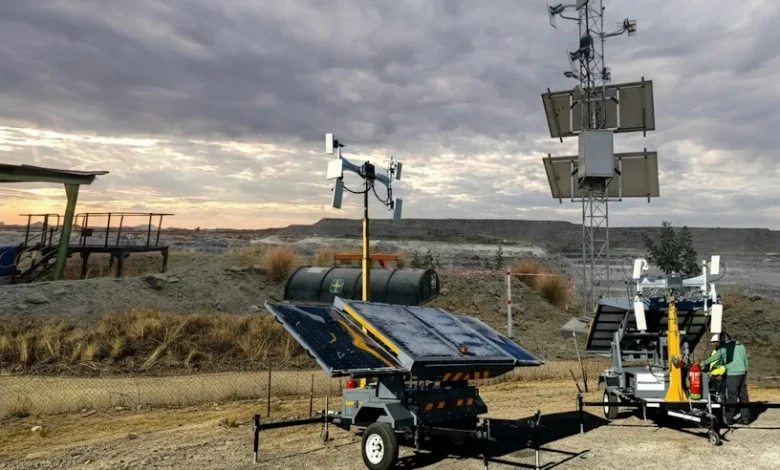
As the world becomes increasingly digitised, Tharisa Minerals has taken a bold step towards modern mining by transforming its South African open-pit operation into a highly connected, data-driven environment.
Tharisa Minerals’ flagship asset is the Tharisa Mine, an open-pit platinum group metals (PGM) and chrome mining operation located in South Africa’s North West province. The mine lies on the western limb of the Bushveld Complex, which hosts more than 70% of the world’s platinum and chrome resources.
In what is believed to be a first-of-its-kind digital transformation project for an African mine, Tharisa partnered with leading hybrid ICT systems integrator and digital transformation specialist Datacentrix to modernise connectivity across the operation.
According to Datacentrix, Tharisa previously relied on standard 3G coverage through SIM cards installed in selected fleet vehicles. However, this infrastructure could not support the company’s long-term vision of “connected machines and connected people”, where real-time data from mining equipment, operational systems and field personnel flows seamlessly across the site.

This level of connectivity is critical for enabling fleet management, telemetry and safety systems linked to key mining assets such as excavators, drill rigs and haul trucks.
Tharisa Chief Information Officer Paul Collins said the move towards a highly connected environment was driven by the need to keep maintenance teams in the pit connected at all times.
“Without reliable connectivity, the mobility and efficiency of our teams were limited,” Collins explained. “The simplest way to describe it is that the hotspots are always moving. You don’t want to constantly rebuild your network infrastructure to accommodate this. It needs to adapt automatically as the operational environment evolves.”
Traditional wireless technologies, including mesh networks and private LTE or 5G systems, were assessed but ultimately failed to meet Tharisa’s operational and financial requirements due to high costs, complexity and limited adaptability.
“We did consider LTE and 5G, but the cost simply didn’t justify the value for our use case,” Collins noted. “We’re a low-cost producer, so we actively seek solutions that support this strategy.”
Datacentrix Solutions Architect Gys Malan said the key challenge was identifying a solution capable of delivering LTE- and 5G-like functionality without the associated expense and operational complexity.
“Tharisa also needed something easy to manage, without the overhead typically associated with traditional mesh networks,” Malan added.
To address these challenges, the two companies identified RADWIN’s FiberinMotion technology as a suitable alternative. The solution offers high throughput, low latency and the ability to support mobility in demanding mining environments.