Preventing bolt failures in mining with real-time bolt load monitoring
Discover how real-time mill liner bolt tension monitoring reduces failures, prevents downtime, and enables predictive maintenance in mining
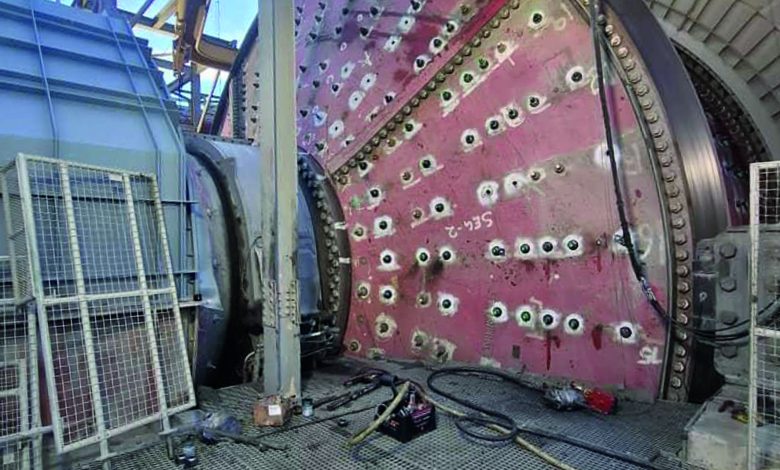
In mining operations, few assets are as critical as SAG mills and ball mills. These massive rotating machines are responsible for crushing and grinding ore into smaller particles, forming a crucial part of the mineral processing chain. Inside the mills, steel grinding balls continuously impact the ore with extreme force, creating one of the harshest mechanical environments found in industrial applications.
Mill liners protect the engineered mill shell from impacts and wear whilst also transferring energy into the charge to crush and grind the rock. These liners are designed to withstand the impact and abrasion forces generated during operation and are secured using specialized mill liner fasteners. This system – liners, fasteners and mill shell- should not have any moving parts. The cyclical nature of the milling operation means that this system is continually put under variable load conditions. These varying conditions can and often do lead to the fasteners becoming loose. Maintaining the integrity of these bolted connections has always been a major challenge for concentrator operators.
A Persistent Problem in Mining
Different mill liner applications can be highly variable. Some mill liners may last eighteen months, while others can require replacement within six. The wear pattern depends on numerous operational factors including ore composition, throughput, solids density, grinding media charge level, and many others.

The liners themselves are consumable parts, but the real problem often begins with the bolted connection.
During installation, mill liner bolts are frequently tightened using non-calibrated impact wrenches, inconsistent lubrication methods, or outdated torque procedures. While the bolts may appear correctly installed, the actual preload inside the bolted joint is often unknown.
This creates significant risks in an application already exposed to severe vibration, cyclic loading, and constant mechanical shock.
Studies and field measurements have shown that newly installed mill liner bolts can experience substantial tension loss shortly after mill start-up. As bolt tension decreases, the loss of preload transfers the full burden of cyclic external loads onto the bolt itself. Eventually, bolts can fatigue and fracture completely.
Once this happens, the consequences can become severe. In many cases, operators are forced into emergency shutdowns to replace broken bolts. These emergency shutdowns are a major cause of unplanned downtime.
From Reactive Maintenance to Predictive Maintenance
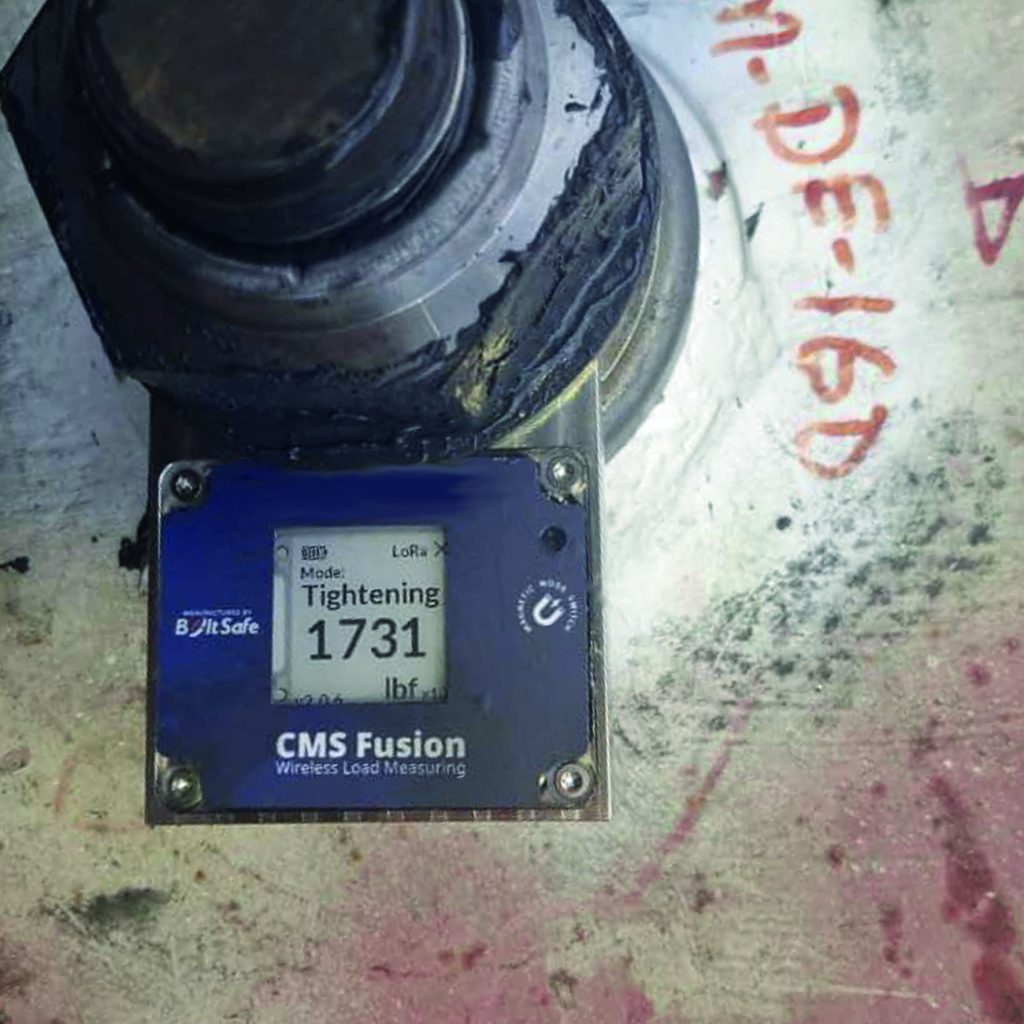
To solve this problem, BoltSafe and ME Elecmetal worked together to develop the CMS Fusion Bolt Tension Sensor specifically for mining customers facing recurring mill liner bolt failures.
The objective was clear: provide operators with continuous, real-time insight into the actual tension inside critical mill liner bolted connections.
The CMS Fusion combines direct bolt tension measurement, integrated display functionality, and wireless LoRaWAN communication into a single compact sensor solution.
Unlike traditional torque methods, the CMS Fusion measures the real tension inside the bolt itself. This allows maintenance teams to verify with certainty that each mill liner bolt has achieved the correct preload during installation.
This is particularly important in mining environments where installation conditions are rarely ideal and where torque alone is often an unreliable indicator of the actual tension achieved.
Real-Time Monitoring Inside Critical Applications
The advantages do not stop after installation.
Once mounted, the CMS Fusion Sensors continuously monitor bolt tension throughout operation. Sensor data is transmitted wirelessly to the monitoring platform, enabling maintenance teams to remotely track the condition of critical bolted joints in real time.
If preload begins to decrease beyond acceptable thresholds, operators receive immediate visibility into the issue long before catastrophic failure occurs.
This changes the entire maintenance philosophy.
Instead of reacting to bolt failures after breakage has already occurred, mining companies can now implement true predictive maintenance strategies based on actual bolt condition data.
Even more importantly, maintenance can become highly targeted. Rather than re-applying torque to all bolts on the mill, operators can identify exactly which bolt locations require attention.
This significantly reduces maintenance time, minimizes unnecessary inspections, and greatly reduces the chances of unscheduled downtime as a result of bolt failures.
Built for Harsh Mining Conditions
Mining applications demand equipment capable of surviving extreme operating conditions. Dust, moisture, vibration, impact loading, and temperature fluctuations quickly expose weaknesses in conventional monitoring technologies.
The CMS Fusion was engineered specifically for these environments.
Its compact and rugged design integrates the electronics directly into the sensor body while maintaining the durability required for heavy industrial use. Combined with low-power LoRaWAN communication technology, the system can operate for the entire liner campaign with minimal maintenance requirements.
For remote mining sites, this is a major operational advantage.
Proven Impact in the Field
The first mining customers deploying the CMS Fusion reported significant improvements almost immediately.
Unplanned downtime caused by fastener failures was eliminated, maintenance became more predictable, and critical bolted joints could finally be monitored based on real measured data instead of assumptions.
Just as important, the system proved itself to be highly reliable in one of the toughest industrial environments imaginable.
A robust and dependable solution that simply does what it promises.
The Future of Mill Liner Fastener Integrity Monitoring
As mining operations continue to focus on reliability, asset availability, and predictive maintenance, continuous bolt load monitoring is becoming increasingly valuable.
Critical bolted joints can no longer be treated as static components installed once and then forgotten. In high-impact applications such as SAG mills and ball mills, bolt preload is dynamic, constantly changing under operational stress.
The CMS Fusion gives mining operators visibility into this process.
And in an industry where every hour of uptime matters, that visibility can make all the difference.