The month of July began with a strong focus on mine protection as industry leaders, security experts and mining executives gathered at the 5th annual Mine Security Conference and Tech Expo, held at the Indaba Hotel in Johannesburg from July 1-2.
While discussions covered a broad range of security risks facing the mining sector, one theme that consistently stood out was the insider threats within the industry. It was highlighted that the greatest danger to mining operations often comes not from outside criminal syndicates, but from individuals within organisations who exploit security weaknesses or collaborate with illegal mining networks.
A recurring message throughout the conference was the need for stronger human capital development in mining security, with comprehensive training and greater awareness required across the entire mining value chain.
Corruption fuels illegal mining

Addressing delegates, Dr Lincoln Cave identified corruption as the single biggest enabler of illegal mining, describing it as a problem that extends far beyond criminal syndicates operating on mine sites.
Drawing on examples from South Africa, Nigeria, Ghana and Tanzania, Cave said illegal mining is sustained by a network of participants that can include corrupt employees, security personnel, suppliers, community collaborators and, in some instances, public officials.
He also highlighted the role that professionals such as accountants, lawyers and precious metals dealers can play in facilitating illicit activities, whether knowingly or inadvertently.
“While these professionals provide essential services, they can also become enablers of illicit financial flows if adequate oversight and accountability are lacking,” Cave said.
Illegal mining carries a heavy economic cost
Joe van der Walt of Focus Group expanded on the economic impact of illegal mining, describing unemployment as one of the primary drivers of the problem in South Africa.
Given mining’s significant contribution to the country’s economy, he argued that illegal mining undermines economic growth while strengthening organised criminal networks.
According to figures presented during the conference:
- Illegal mining costs South Africa more than R70 billion every year.
- At least 5% of the country’s annual gold production is lost to illicit activities.
- More than one million tonnes of chrome ore are illegally exported annually, representing over 10% of legal production.
- The number of illegal miners is estimated to exceed 50 000, increasing more than tenfold over the past two decades.
The enemy within
Van der Walt argued that mining companies need to elevate security from a support function to a strategic business priority, particularly as organised mining crime becomes increasingly sophisticated.
He stressed that understanding criminal networks is fundamental to building an effective security strategy.
“I believe we still do not fully understand our adversaries or give them the level of respect they deserve. Once you understand who you are dealing with, you are better positioned to anticipate their actions, identify vulnerabilities and strengthen your response,” he said.
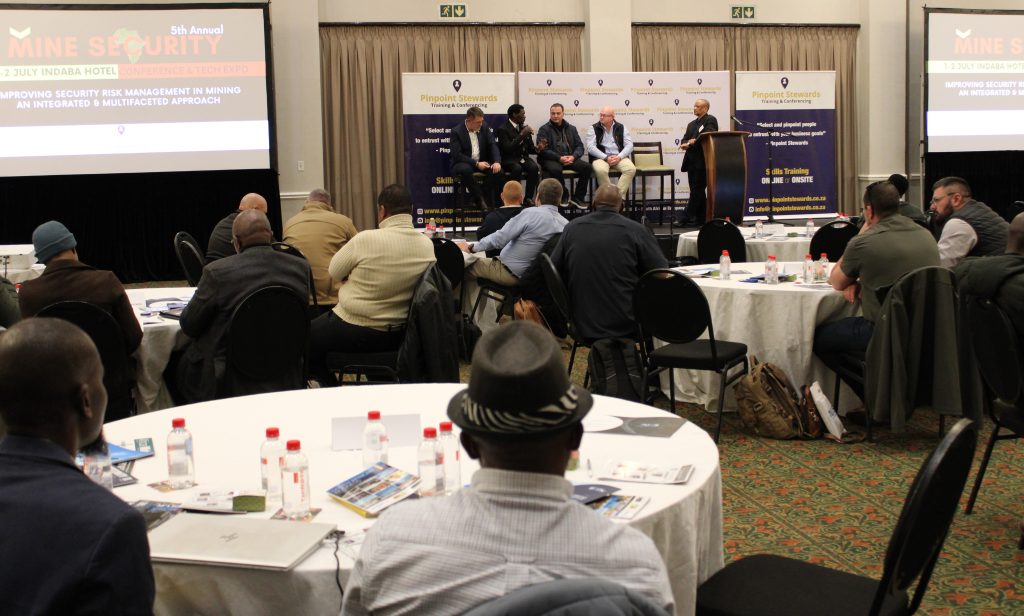
While illegal miners, commonly known as zama zamas, remain the most visible threat, Van der Walt said internal actors often pose the greatest risk.
“As security managers we must recognise that the most dangerous adversaries are those within our own organisations, the individuals among us,” he said.
These insider threats include employees motivated by financial gain, individuals seeking revenge or influence, poorly trained staff whose mistakes create vulnerabilities, as well as compromised procurement officials, security personnel and labour representatives who become influenced by criminal syndicates.
According to Van der Walt, financial motivation remains the strongest driver.
“Those who have no money long for some, those who have some money strive for more, those who have the most hoard it jealously. At this stage, criminality is often opportunistic rather than ideological,” he said.
He added that organised crime is becoming increasingly sophisticated, with syndicates seeking not only to extract minerals illegally but to establish and control parallel mining economies that operate alongside legitimate businesses.
Moving from reaction to prevention
Rather than continuing to respond to incidents after they occur, speakers agreed that the mining industry needs to adopt a proactive, intelligence-led approach to security.
Among the key recommendations presented were integrating security into executive decision-making, developing a mission-driven security culture, and focusing on dismantling criminal networks instead of merely containing their activities.
Technology was also identified as a critical enabler. Experts advocated combining human intelligence gathered from employees and surrounding communities with advanced data analytics, artificial intelligence, biometric access control and integrated Security Information and Event Management (SIEM) platforms to detect suspicious behaviour before incidents occur.
Enhanced vetting and continuous re-vetting of employees and contractors, particularly those working in high-risk areas such as processing plants, refineries and control rooms, were also highlighted as essential measures.
Beyond technology, speakers emphasised the importance of building an organisational culture based on integrity through continuous training, anonymous reporting mechanisms, and recognising employees who identify irregularities.
They also acknowledged that addressing the socio-economic factors driving illegal mining remains vital. Creating legitimate employment opportunities, supporting surrounding communities and reducing the conditions that make recruitment into criminal syndicates attractive were identified as equally important components of long-term security.
A shared responsibility
The conference made it clear that the mining industry’s security challenge extends far beyond physical infrastructure and perimeter protection. As organised crime becomes more sophisticated and increasingly reliant on insider collaboration, mining companies must rethink how security is managed.
Protecting mines will require more than stronger fences and surveillance systems. It will depend on creating resilient organisations where security is embedded in business strategy, employees become the first line of defense rather than the weakest link, and intelligence, technology and collaboration work together to stay ahead of increasingly organised criminal networks. Only by tackling both the human and operational dimensions of security can the industry hope to safeguard its people, assets and long-term sustainability.