Midas Minerals reports high-grade copper results from Namibia prospect
Initial drilling at the Hartbeespoort Prospect has returned copper, gold and silver intercepts, with further assay results expected before the end of 2026
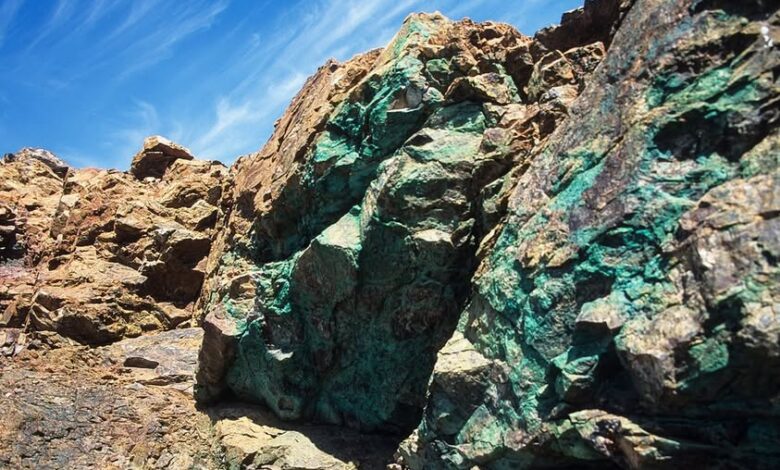
Midas Minerals has reported encouraging copper results from its initial drilling programme at the Hartbeespoort (HBP) Prospect, part of its Otavi Copper Project in Namibia.
The company completed 47 reverse circulation (RC) holes covering 3,427m at the prospect, which extends over 3km and is located approximately 5km south-east of the Deblin deposit.
Results from the first eight holes have returned several copper intercepts, accompanied by gold and silver mineralisation. These include 14m at 3.86% copper (Cu) and 7.5g/t silver (Ag) from 60m in hole HBRC005. The intercept included a higher-grade section of 4m at 9.83% Cu and 15.5g/t Ag from 61m.
Other significant results include 7m at 2.37% Cu and 8.0g/t Ag from 24m in HBRC008, including 3m at 4.66% Cu, 0.14g/t gold (Au) and 9.3g/t Ag from 28m.

Hole HBRC003 returned 3m at 2.73% Cu, 1.50g/t Au and 23.0g/t Ag from 35m, while HBRC001 recorded 6m at 1.33% Cu, 0.35g/t Au and 5.5g/t Ag from 34m.
The HBP Prospect has been known since the early 1970s, when exploration identified elevated copper concentrations in soil samples and several surface exposures containing malachite and chalcocite, both copper-bearing minerals.
Previous drilling by Nexa also returned copper mineralisation, including 11m at 3.11% Cu, 0.54g/t Au and 28.4g/t Ag from 26m in hole NDDH16.
Midas carried out additional soil sampling in 2026, identifying several copper and gold anomalies associated with two domal geological structures extending over a strike length of more than 4km.
Mineralisation at HBP occurs close to the boundary between Ombombo Group sediments and the underlying Askevold metavolcanic rocks. The same geological contact is also associated with mineralisation at the nearby Deblin deposit, where Midas is continuing to investigate a copper, gold and silver system.
Further assay results from the HBP drilling programme are expected in the fourth quarter of 2026. The company also plans additional drilling to establish the extent and geometry of the near-surface oxide and transitional mineralisation, as well as investigate deeper sulphide targets.