A ‘chilled’ HVAC partnership: energy-efficiency, productivity and comfort for the manufacturing, industrial and commercial sectors
As energy costs rise and indoor air quality and process-control requirements become more demanding, Industrial Climate Engineering highlights the importance of correctly designed, controlled and commissioned HVAC systems that match the specific needs of commercial, manufacturing and industrial environments
Heating, ventilation and air conditioning (HVAC) has always been about more than simply cooling a space. Today, however, rising energy costs, more demanding indoor air requirements and increasingly specialised manufacturing and processing are placing even greater emphasis on how temperature, humidity, ventilation and air quality are collectively managed.
“A well-designed HVAC system can support occupant comfort, process requirements, productivity and the overall energy performance of buildings,” says Alin Gomes, Director of experienced HVAC turnkey specialist Industrial Climate Engineering (ICE).
“Importantly, for decision-makers in the commercial, manufacturing and industrial sectors, the real value lies in working with an experienced HVAC specialist which understands clients’ building, process and operating requirements – and can translate these into a practical, efficient solution,“ Gomes explains.
Every building is different

For ICE, effective HVAC design starts with a simple principle: every building and process has its own requirements. Rather than applying a one-size-fits-all solution, ICE considers the building layout, occupancy, internal and external heat loads, required air flow, filtration, pressure relationships and applicable safety and ventilation requirements before developing a system. ICE’s turnkey capability extends from design to fabrication, installation, commissioning and the coordination of related construction and electrical works, with a focus on performance, efficiency and long-term reliability.
Gomes notes that standard packaged or off-the-shelf equipment can be entirely suitable for many applications – however, these are not automatically the best fit for every building or process.
“The important point is correct selection and control. Equipment needs to be sized for the actual load profile and selected for the required operating range, rather than simply choosing a unit on nominal capacity,” he advises.
Modern HVAC equipment may use staged capacity, variable-speed compressors, inverter drives or other controls to respond to changing loads. However, an oversized or poorly controlled system can still cycle excessively, operating inefficiently, struggling with humidity control and wearing unnecessarily: “Good design is about matching the HVAC plant to the building’s actual demand – and ensuring it has the ability to operate efficiently at full and partial load,” Gomes adds.
“People exhale carbon dioxide (CO2), while occupied buildings also contain moisture, odours and other indoor contaminants. Outdoor air is introduced to dilute these contaminants and maintain acceptable indoor air quality. The required outdoor air quality depends on the occupancy and application, in accordance with SANS 10400-0. Ventilation rates vary by occupancy type, and may be expressed as litres per second per person and / or air changes per hour – so the design must be checked against the requirement applicable to the specific space.
Gomes cites examples where clients have called on ICE to improve ventilation after indoor air quality assessments identified insufficient outdoor air: “In one case, the system was recirculating too much return air, and introducing too little outdoor air. We rebalanced the system so that the required quality of outdoor air could be introduced – while maintaining the overall supply air performance.”
ICE always looks for the most practical way to introduce the required outdoor air, but some installations need dedicated ventilation equipment. Depending on the air-conditioning equipment configuration, provision of outdoor air may be limited – or may need to be designed separately.

Alin Gomes, Director of Industrial Climate Engineering (ICE). Picture: Supplied.
“In those cases, we can install a dedicated fresh air system and integrate it with the air-conditioning system,” Gomes explains.
Outdoor air also forms part of the building’s cooling or heating load. On very hot or cold days, bringing untreated outdoor air directly into a conditioned space can increase the energy requirement by the HVAC plant. Where appropriate, ICE can temper or pre-condition outdoor air and consider measures such as heat recovery, so that ventilation requirements are met without placing unnecessary load on the main air-conditioning plant – while also saving energy.
Turnkey HVAC projects
ICE’s turnkey approach is illustrated by two recent projects in specialised process environments, where climate control formed an integral part of the production requirements – rather than simply providing occupant comfort.
The first project involved a large-scale central HVAC plant serving multiple controlled environment production areas. The system provides heated and chilled water together with multiple stages of filtration – including high-efficiency particulate air (HEPA) filtration – to maintain closely controlled temperature and relative humidity conditions.
“The filtration and environmental control requirements were significantly more stringent than those of a typical comfort-cooling installation,” Gomes observes.
The temperature-sensitive production process itself shaped the air distribution strategy. According to Gomes, directing cold supply air onto the product could have caused damaging localised temperature stress: “We therefore designed the air movement to avoid direct cold draughts across the sensitive production area – and used controlled circulation within the space to achieve a more even temperature,” he notes.
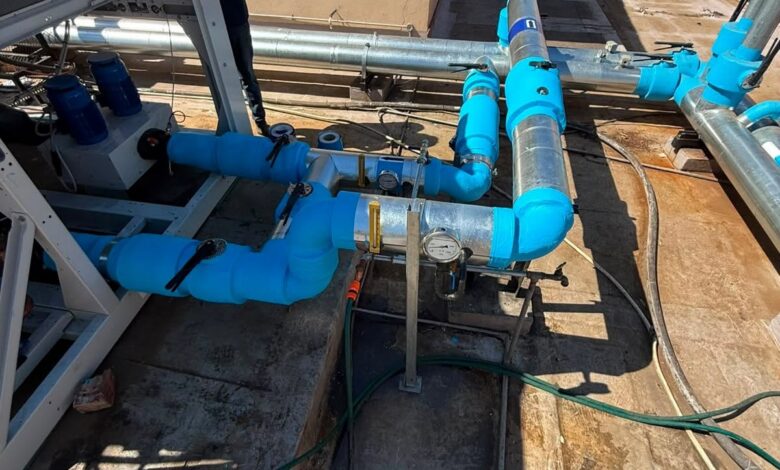
Furthermore, high solar heat gain through the building envelope created another substantial design challenge, with extreme temperatures recorded within the production environment. The central chiller plant is positioned remotely from the conditioned area, and connected through steel pipework to the air-handling equipment. The controls coordinate cooling, heating and ventilation to maintain the required conditions as the load changes.
The second process-cooling project required a simpler solution – but equally careful control. Large circulation and ventilation fans manage air movement, while the key requirement for ICE was to maintain the process medium and supply water at a stable temperature: “We therefore cooled the water to a carefully controlled set point suited to the production requirement, using heat exchangers to separate the chiller’s closed water circuit from the client’s process-water circuit. Rather than passing process water directly through the chiller, the heat exchanger transfers cooling between the two circuits. This protects the chiller water loop – while allowing the process water to be managed according to the production application’s specific water-quality,” Gomes clarifies.
A new ‘ICE’ age for HVAC
HVAC technology continues to improve, particularly in compressor control, heat exchanger design, fans, controls and refrigeration selection.
“Energy performance should be assessed against actual operating conditions and the efficiency rating of the selected equipment. Using an Energy Efficiency Ratio (EER) of 2.6 as an example, the system provides approximately 2.6Kw of cooling for every 1Kw of electrical input at the stated rated condition.
The higher the EER, the less electrical input is required for the same cooling duty. Also, R-32 is one of the lower Global Warming Potential (GWP) refrigerants now used in selected air-conditioning and chiller applications – although refrigerant choice must always suit the equipment type, capacity, safety requirements and application,” Gomes explains, pointing to an ICE project in Johannesburg where measured electricity consumption reportedly fell by approximately 21% – 23% after the rooftop chiller plant was replaced.
He cautions, however, that savings vary from project to project – and depend on the efficiency of the existing plant, operating hours, controls, load profile and the replacement HVAC technology.
“The opportunity for performance and sustainability improvement is not only in replacing equipment. Correct sizing, controls, commissioning and ongoing optimisation all contribute to HVAC energy efficiency and savings – while maintaining the climate conditions which the building or process requires,” Gomes concludes.