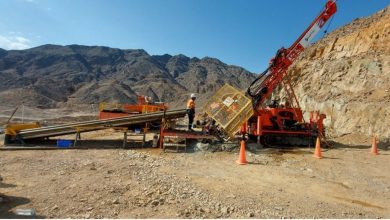

Aya Gold & Silver announces results from 2022 drill exploration program at Boumadine property
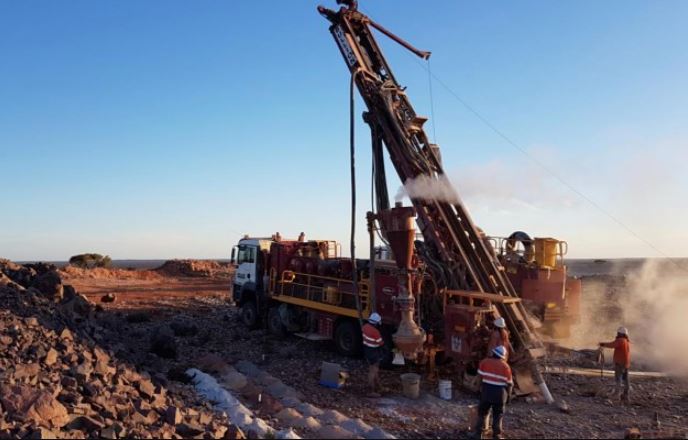
Aya Gold & Silver Inc. is pleased to announce initial drill results and mineralized intersections from the 2022 drill exploration program at its brownfield Boumadine property in the Kingdom of Morocco.
“We are excited with these high-grade drill results at Boumadine, which indicate mineralization over 2.7 kilometers and confirm our belief that Boumadine has tremendous potential,” said Benoit La Salle, President & CEO.
“The results to date demonstrate a robust, near-surface, polymetallic system with continuity in multiple lenses that remains open in all directions. In particular, hole BOU-DD22-036 is a very rich intersection on the southernmost section with ample room to extend the strike length. As we expand our drilling program and understanding of the mineralizing system, we grow more confident in the potential to uncover the next big discovery in Morocco.”
“Boumadine represents our next leg of growth, together with Zgounder Regional where we are also mobilizing drill rigs and deploying resources to add high-grade ounces. Our focus at Boumadine near term will be on in-fill drilling within the Central and South Zone targets, completing further step-out holes at depth and along the main trend; and assessing the potential to make additional discoveries along this over 6-kilometer mineral-rich hydrothermal system,” he added.
2022 Exploration and Drilling Programs
The 2022 drill exploration program at Boumadine consisted of 38 DDH or a total of 7,500m over 6 sections, two of which in the Central Zone, and four in the South Zone. Our objective was to test the mineralization and the continuity between the Central and the South Zones against our analysis and geological interpretation. This new interpretation was informed by results from the hyperspectral survey, historical drilling review and a detailed field study.
The historical database (pre-2020) consists of a mix of 661 drill holes and or channel and or trenches totaling 30,358m; most of which were completed over the Central Zone and to a lesser extent over the North, South, Imariren and Tizi Zones. In addition, some mining development data exist for the Central (three levels) and South (two levels) Zones. Although the data guided the plan for our 2022 drill program, to date we have not assessed the reliability of the data. Furthermore, our press release of May 28, 2020 regarding studies and information pertaining to non-material assets of the Corporation remain applicable as at the date hereof.
To date, the results of 38 DDH have been received with one hole extension, BOU-DD22-028, still pending. In view of this exploration success, the drilling program at Boumadine has been increased by an additional 6,000m to cover the North Zone, Imariren, Tizi and the South-West Zones.
The mineralization consists generally of 1m to 4m wide (locally reaching over 10m width) N340- oriented massive sulfide lenses/veins sharply dipping eastward (> 70°). The massive sulphide veins (>80%) are composed mainly of pyrite, with variable proportions of sphalerite, galena, and chalcopyrite.
Within the massive sulphide veins, zones of breccias are present with silicified angular fragments and round fragments completely replaced by pyrite. These zones underline the presence of syn-volcanic faults used by the mineralization. Replacement of fragments by pyrite in weathered felsic tuffs locally induces large zones several tens of meters thick of sub-economical anomalous values. These wide zones are interpreted as the upper part of the hydrothermal system. The assay results show a strong correlation between the gold, silver, and copper values. A weaker correlation exists with zinc, lead and molybdenum.
The mineralization is mainly in a sequence of volcaniclastic rock composed of felsic tuff and mafic tuff. The felsic tuffs are composed of angular to rounded centimetric felsic fragments, quartz eyes, and plagioclase crystals, with locally mafic fragments. This sequence is generally homogeneous and massive and rests in unconformity on mafic tuffs. The mafic tuffs are characterized by a variable percentage of amphibole crystals and exotic fragments of sedimentary rocks, confirming their clastic origin. Those tuffs are interpreted as having a volcaniclastic origin, sedimentation in an underwater basin.
Intrusive rocks are divided into two groups: pre- to syn-mineralization and post-mineralization. Pre- to syn-mineralization dykes are mainly felsic to intermediate in composition, aphanitic to porphyritic in texture and are found as dykes or sills in both mafic and felsic tuffs, suggesting bimodal volcanism. Late intrusions are mainly rhyolitic subvolcanic domes that cut mineralization and are spatially associated with normal faults. They are interpreted as being synchronous with the post-mineralization deformation episode that segmented the mineralized zones. A swarm of regional extended mafic dykes cut each lithology on the property.
Two sequences of hydrothermal alteration are observed on the property. The first sequence mainly affects felsic tuff and manifests as phyllic alteration (Quartz-sericite-pyrite). Proximal to the veins, there is an advanced clay alteration composed of kaolinite, pyrophyllite and vuggy silica, suggesting a high-sulphidation epithermal event. The second sequence of alteration mainly affects the underlying mafic tuffs and consists of large-scale propylitization (epidote and chlorite). Near the veins, the alteration is composed of black chlorite, pyrophyllite and pyrite. The transition between these two alterations is relatively rapid and consistent with the change in composition of the tuffs and suggests chloride fluids rich in Fe, Zn and Pb, typical of VMS style mineralization.
Preliminary results confirm the continuity in the system between the Central Zone and the South Zone, extending known mineralization over a 2.7km strike length and remaining open in all directions. Drilling so far also supports the potential for very rich, large lenses of massive sulphide as shown by the results in BOU-DD22-002, BOU-DD22-004, BOU-DD22-021and BOU-DD22-036. In addition, the high values of Zn and Pb over large widths should significantly increase the potential and economic value of Boumadine.
During the ongoing drill program, mapping and prospecting is being extended by our field geologists. Many new mineralized structures and zones of high alteration are currently being identified within the permit perimeter.
Next Steps
The drilling program has been expanded by 6,000m to cover the Imariren, Tizi and South-West Zones and is expected to be completed in November 2022. The airborne geophysics data, which is expected in September 2022, will inform the new targets and the follow-up of extensions of known mineralization. Furthermore, the QA/QC and reliability of the data from historical drill holes will be fully assessed to determine which data, if any, can be used towards a NI 43-101 compliant resources estimation.