

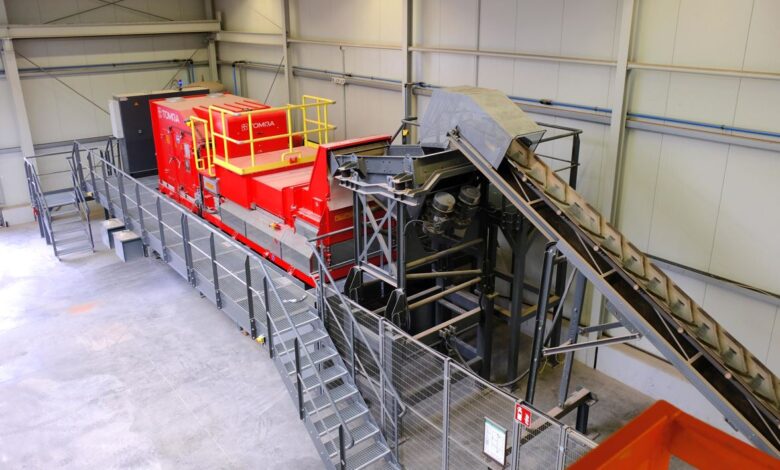
X-ray technology (XRT) offers more than just efficient recovery—it lowers operating costs and leads to the discovery of high-quality, high-value stones.
Increasing OPEX, regulatory compliance bottlenecks, and the increasing shift to underground operations – together with its associated high costs – are common challenges encountered in the contemporary mining environment. The diamond mining sector is not an exception to these trends.
A noticeable challenge unique to diamond mining is reduction of miner product output. Consequently, this has necessitated the urgent need to ‘do more with less’.
For this reason, the objective of contemporary diamond mining is recovering large, high-quality kimberlite diamonds at the highest sorting efficiency with the highest throughput possible.

And it must be added that the earlier the process is carried in the flow-sheet the better. As highlighted in SAIMM review1: “Earlier recovery of diamonds from the system lessens the exposure of diamond-bearing ore to additional materials handling, pumping, and/or crushing, which has been known to damage or even break diamonds and decrease revenue.”
However, this is challenging to achieve with conventional diamond recovery techniques, inherent with their limitations.
Conventional techniques
There are several conventional methods at the disposal of diamond producers. Commonly in use are near-infrared (NIR) and X-ray luminescence (XRL), and traditional XRL sorters.
While these techniques serve the purpose, they come with inherent limitations. For instance, NIR and XRL are dependent on visible colour difference or clean, reflective particle surfaces, while traditional XRL sorters have low detection rate for type II diamonds.
XRT technology
In a stark contrast, XRT technology has a significantly higher detection rate. This is the rule of thumb: the success of detection with X-ray transmission (XRT) technology depends on the difference in atomic numbers between the materials being separated.
Unsurprisingly, X-ray transmission has emerged as the preferred recovery technology in diamond flow sheet in applications, specifically in recovery and final product grading across all size ranges. Applications of X-ray transmission (XRT) sorting are found across kimberlite, alluvial, and marine operations.
In comparison to other methods, the advantage of XRT is that it delivers considerably lower percentage yield, comparatively lower running costs with respect to consumables and utilities. What’s more, even at high feed rates, it leaves minimum gangue materials.
Milestones
Record recoveries that are making headlines attest the effectiveness of XRT. Isn’t it incredible that most of the discoveries are of stones above 1000 carats?
With anticipation, with new breakthroughs from R&D initiatives, enhanced by AI and deep learning, XRT technologies will only get better, unearthing high value diamonds.
- Pioneering large diamond recovery at Karowe diamond mine – Journal of the Southern African Institute of Mining and Metalurgy Volume 116 – 2016