
Vertical grinding meets demands decarbonisation, lower grades
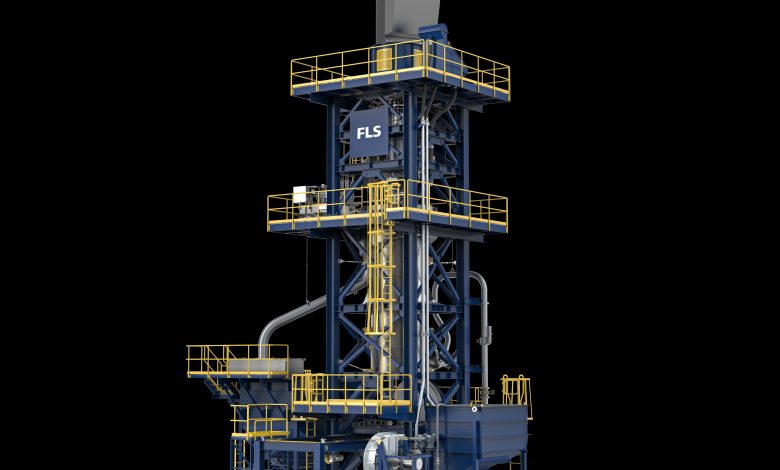
Although vertical mills have long been part of full-flowsheet provider FLS’s comminution portfolio, the company continues to advance this technology to enhance metal recovery and support its sustainability objectives.
According to Peter Wulff, Global Product Line Manager for Vertical Regrind Mills at FLS, vertical media mills, which break down material through attrition rather than impact, are playing an increasingly important role as ore grades continue to decline worldwide.
“As miners seek ways to maintain or improve recoveries from deposits with declining ore grades, vertical grinding mills offer the advantages of internal classification and energy savings in a compact footprint,” says Wulff.
“The vertical orientation of the grinding chamber allows the basic laws of physics to work in our favour, minimizing overgrinding. Finer particles can be discharged quickly from the mill, while coarser particles remain within the grinding media charge until further reduced in size. This enables finer grinding while consuming less energy than traditional horizontal ball mills for the same duty.”
Vertical mills are recognized for their economical energy consumption compared to horizontal mills, achieving energy savings of 25 to 30 percent, which translates to a lower carbon footprint. For certain deposits, such as copper, iron, and lead-zinc ores, this efficiency enhances the profitability of downstream recovery in flotation processes.
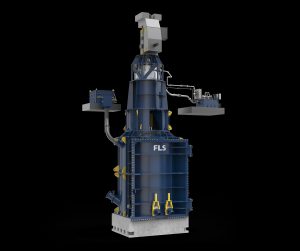
FLS’s tower mill, branded the FTM, features a central agitator screw as its only moving component in contact with the slurry and steel media. This design reduces energy and media consumption in hard ore applications and minimizes water use in secondary and tertiary grinding due to the high solids’ concentration in the feed. Robust component design and proven wear materials provide higher operational availability, further enhanced by intelligent operations management software to optimize circuit performance.
Another vertical grinding solution from FLS is the VXPmill, which uses ceramic media rotated by a variable speed disc assembly, allowing customization for specific grinding duties. This vertical ceramic media stirred mill is suited for finer grinding applications and can easily achieve product sizes below 20 microns. The system employs a modular impeller with removable discs and spacers to adjust the number of discs in operation, enabling precise control of product size while avoiding excess energy consumption.
The vertical footprint of FLS’s grinding mills offers the advantage of occupying relatively little space in a processing plant.
“Compared to horizontal mills of the same capacity, the smaller footprint supports plant space optimization and requires less costly civil infrastructure for the base,” says Wulff. “This makes retrofitting into existing plants easier, especially where space is constrained.”
Cost effectiveness is further enhanced by lower capital expenditure, as components are factory-tested and pre-assembled for rapid on-site erection, resulting in significantly shorter lead times for installation and commissioning. Combined with energy efficiency and high uptime, these factors contribute to the lowest total cost of ownership.
A recent indication of this technology’s popularity was an order from a customer in India for 18 FLS FTM 5000 vertical tower mills, the largest order yet for FLS and the wider industry. The mills will serve what is expected to become one of the world’s most efficient iron ore beneficiation plants.
Notably, these vertical grinding mills will be the largest of their type ever built and will be employed in two separate grinding stages. In a typical tertiary grinding application, the first stage of FTM tower mills receives the screened product from FLS’s largest HPGRs, featuring 3-meter diameter rolls with 2-meter width. The second stage of FTM 5000 mills processes the magnetic fraction from the previous stage to further upgrade the iron content.