
Understanding of material and flow underpins Weba chute design
Understanding material behaviour at transfer points is the foundation of efficient, reliable and low maintenance bulk material handling systems.
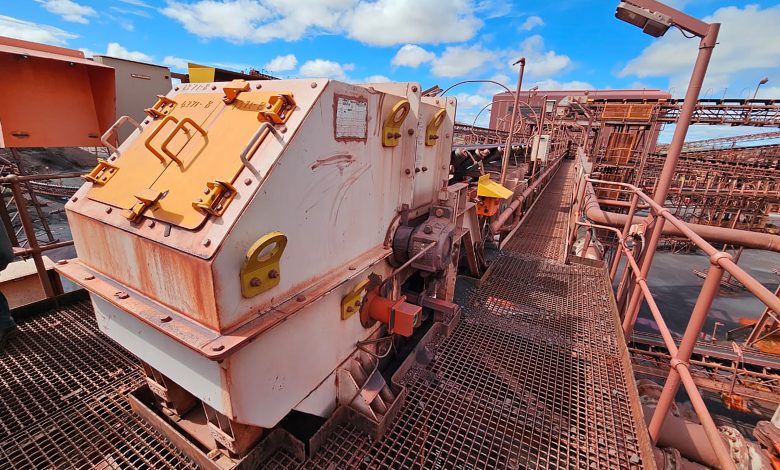
The performance of any transfer chute in a mining or bulk material handling operation depends largely on how well it is designed to handle the specific material being transported. From sticky ores to abrasive run of mine feed, each material presents unique challenges that demand careful engineering and practical expertise.
The success of a custom engineered transfer chute begins with understanding how a specific material will behave at the transfer point and then applying both scientific principles and practical experience to achieve the optimal design.
According to Dewald Tintinger, Technical Manager at Weba Chute Systems, the company’s approach combines a strong foundation in material flow science with decades of field experience to deliver reliable chute designs across a wide range of industries.
“Whether handling sticky manganese ore, cohesive clay or abrasive lumpy run of mine feed, it is vital to base chute design on a detailed understanding of how materials flow, compact and interact with liners and geometry,” he says. “Every material behaves differently, so we can’t apply a one size fits all rule.”

The science behind material flow
Designing a transfer chute begins with bulk flow analysis, which helps engineers understand how materials will behave during operation. This analysis is often conducted in laboratory conditions using a representative fine fraction of the material, typically the minus 4 mm portion.
During testing, samples are evaluated under different moisture levels, pressures and flow angles to determine how easily the material will move under conditions similar to those in a processing plant.
“This lab work tells you part of the story but minus 4 mm material might only make up 20 to 30% of the actual particle size distribution,” Tintinger notes. “The real challenge is integrating that data with the larger lumpier portion of the material mix.”
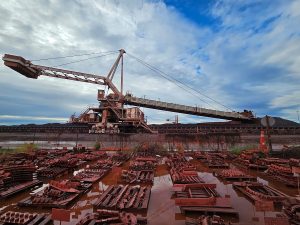
This is where practical experience becomes critical. Drawing on knowledge from more than 5,000 chute installations worldwide, engineers at Weba Chute Systems have developed design parameters that reflect how mixed size materials behave collectively in real operational environments.
“It is something we have refined over years of lessons learned,” he adds. “The data is important but knowing how to interpret and apply it to real world conditions is where our expertise really comes through.”
Digital tools supporting modern engineering
Advanced digital technologies are also contributing to the design process. Discrete Element Modelling, known as DEM, is increasingly used in the industry to visualise how bulk materials move through transfer points.
While Weba Chute Systems uses DEM extensively, Tintinger emphasises that the technology is best applied as a verification and communication tool rather than the primary design method.
“DEM is valuable as a validation and communication tool and a way to show clients how the material will behave once it is flowing,” he says. “It helps verify flow patterns, impact zones and wear areas and therefore supports our established design methodology in delivering long term reliability and low maintenance performance.”
Despite its benefits, DEM simulations have certain limitations. They typically replicate only 60 to 240 seconds of material flow, whereas real operational challenges such as blockages or buildup can develop over much longer periods.
The technology also cannot fully reproduce environmental factors like heat, humidity or the fines generated by belt scrapers and cleaners, all of which influence how materials behave in actual plant conditions.
Combining physics, data and experience
To overcome these limitations, Weba Chute Systems relies on its established design methodology known as the continuum method, a traditional physics-based approach that has guided the company’s engineering practices for decades.
“Our core methodology remains rooted in what we call the continuum method, a traditional physics-based design approach that has been the backbone of the company’s success,” Tintinger explains.
By combining laboratory data, advanced visualisation tools and extensive field experience, the company continues to develop transfer chutes that perform reliably across different commodities and operating environments.
Ultimately, this balanced approach ensures that each custom engineered chute is tailored to the specific material it handles, improving efficiency, reducing wear and supporting long term operational reliability.