
Simandou project reaches critical stage as Guinea emerges as global iron ore powerhouse
Africa’s largest mining and infrastructure development is moving from vision to reality, positioning Guinea at the centre of global iron ore supply and redefining how large-scale mining consortia are built and delivered.
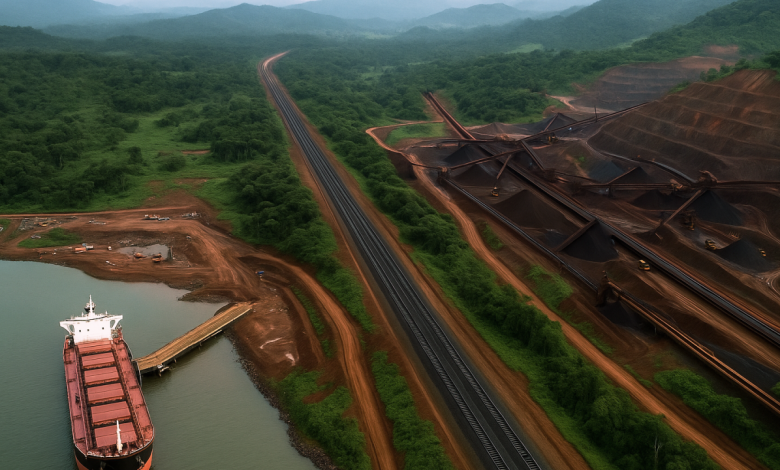
Simandou, Africa’s largest mining and related infrastructure project, has reached a pivotal phase of development as construction, testing, and commissioning advance across its vast mine, rail, and port network.
Spanning more than 600 km of trans-Guinean railway and supported by new deep-water port facilities, the project is not only transformative for Guinea’s economy but also represents a landmark in international consortium collaboration within the global mining sector.
Developed through a partnership between SimFer and Winning Consortium Simandou (WCS), the project comprises two integrated iron ore mines, shared rail infrastructure, and port facilities capable of exporting up to 120 Mt of iron ore annually at full capacity, equally split between the two operators.
SimFer, a subsidiary of Rio Tinto, holds rights to Blocks 3 and 4 in the southern half of the project, while WCS controls Blocks 1 and 2 in the north.
SimFer is a joint venture between the Government of the Republic of Guinea and SimFer Jersey Limited, owned by Rio Tinto and Chalco Iron Ore Holdings, a Chinalco-led consortium that includes major Chinese state-owned enterprises such as China Baowu Steel Group. WCS, meanwhile, brings together Singapore-headquartered Winning International Group, China’s Weiqiao Aluminium, and Baowu Resources, reflecting the project’s truly global ownership structure.
Rio Tinto is responsible for developing Simandou’s southern blocks, where inferred resource estimates indicate ore reserves of 1.5-billion tonnes and mineral resources of 1.3-billion tonnes. Both SimFer and WCS are constructing their own mines, while jointly developing shared rail and port infrastructure that will be owned and operated by La Compagnie du Trans-Guinéen (CTG).
CTG, a joint venture between the Government of Guinea, SimFer, and WCS, will operate the 670 km railway and deep-water port that will transport iron ore from the mines to the coast. The infrastructure includes 12 stations, more than 200 bridges, and four tunnels, underscoring the scale and complexity of the development.
Rio Tinto says the Guinean government has mandated ambitious delivery timelines, prompting all partners to commit to an accelerated schedule while maintaining international standards in safety, governance, environmental stewardship, and social responsibility.
Testing and commissioning of the rail and port infrastructure are already under way, with both SimFer and WCS having begun transporting ore along the trans-Guinean railway as part of this process.
“Under the port construction plans, SimFer will initially use the WCS-built port facilities until its own trans-shipment vessel port facilities are completed and commissioned in 2027. Once the commissioning of the rail and port infrastructure has been completed, CTG will take over the shared infrastructure,” Rio Tinto says.
After the first ore was produced in 2025, SimFer transported its initial ore in October as part of commissioning activities. Key milestones include completion of the SimFer rail spur and main rail line in 2026, initial shipping through the WCS barge port, commissioning of SimFer’s trans-shipment vessels in 2027, and the ramp-up of SimFer’s mine to 60 Mtpa by 2028.
The project is already delivering social and economic benefits, with around 25 000 employees and contractors currently working across the SimFer scope, 82% of whom are Guinean nationals.
At the official opening of the Simandou project in November at the port in Forécariah prefecture, Rio Tinto chief executive Simon Trott highlighted the significance of collaboration in delivering the project.
“This outstanding achievement has been made possible through the dedicated hard work of thousands of our colleagues, and the complementary strengths and expertise of Rio Tinto, our SimFer partners, the Government of Guinea and WCS. We are unlocking an exceptional new source of high-grade iron ore that is in demand from customers for low-carbon steel making, enhancing our world-class portfolio of iron ore mines in the Pilbara [Australia] and Canada.”
Trott described Simandou as a defining moment for the mining industry, adding:
“This project is a game-changer, the first time an international consortium of this kind has come together to deliver a project on this scale and at this pace. Yes, it has been complex but tackling those challenges side by side as partners has only made those relationships stronger.”
As Simandou advances toward full production, it stands as a model for future mega-projects, demonstrating how multinational partnerships, host governments, and global miners can work together to unlock world-class resources while supporting long-term national development.