
Opinion: Skid-mounted and mobile air-cooling systems: Innovations to allow flexible and unconstrained mining
Deep mines operate under some of the most technically demanding environments in the world. Increasing heat loads, combined with declining ventilation air volumes, conspire to limit the ability of mines to operate safely and profitably. The challenge is not confined to depth alone.
Mines are optimised to target a specific orebody given a fixed set of technical and economic assumptions. Shifting commodity cycles and a changing world have introduced a requirement for flexibility, one that many existing mines were not originally designed to accommodate.
In this new dynamic environment, underground cooling systems cannot remain static but must adapt to changing mining conditions and evolving production priorities.
Conventional bulk air-cooling systems have historically formed the backbone of mine ventilation strategies. While effective, these fixed installations are inherently rigid, capital-intensive systems with long project lead times, and are generally optimised for pre-defined production schedules and mine life.
In reality, however, conditions change constantly, and conventional cooling systems cannot respond with the required agility, leading either to under-cooled hotspots or energy inefficiencies from overcooling already cool areas. The ideal mine cooling system must be flexible and must not be a constraint to mining.
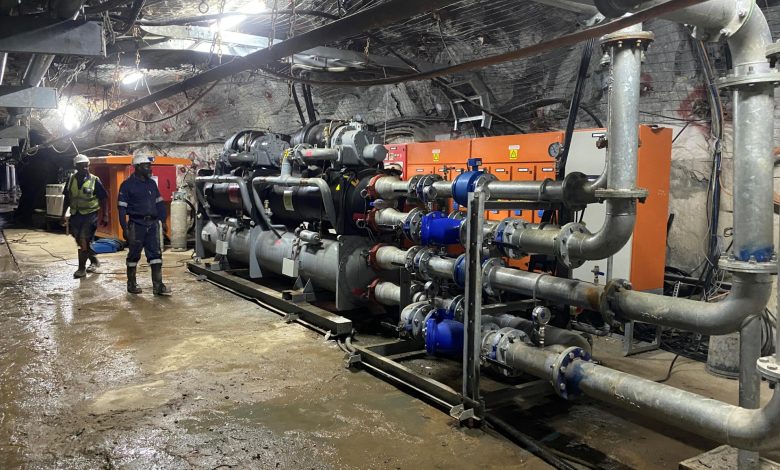
A need has emerged for short-term underground cooling solutions that can adapt to changing conditions and provide more targeted temperature control than possible with conventional bulk air-cooling systems. This need has motivated BBE to develop modular, skid-mounted air-cooling systems designed for rapid deployment and adaptable service in dynamic mines.
The cooling system is designed to provide air cooling exactly where it is needed, while integrating with existing ventilation infrastructure.
The skid mounted, air cooling system is self-contained and transportable
Instead of relying solely on bulk air cooling from a central refrigeration plant to cool an entire mine, targeted area cooling of individual, hot mine ventilation districts can be provided. This approach delivers high positional efficiency by delivering cooling capacity only to areas that require it.
This technology is suited to new mine developments where a central cooling system is not yet in place, as well as in existing mines where central cooling plants can be less effective over long distances and additional air cooling is required.
Skid-mounted underground area air-cooling systems offer flexibility, as they can be rapidly deployed or relocated. As production priorities shift, air cooling capacity can be redeployed accordingly, without the need for permanent infrastructure modifications.
This aligns with the dynamic nature of modern mining, where flexibility is essential to increase output during high-commodity-price cycles without committing capital that will not be required during a period of low commodity prices.
This type of underground air-cooling system also enhances positional efficiency by applying cooling only where it is needed. This avoids the inefficiencies associated with overcooling an entire mine to manage an isolated hotspot, thereby improving overall energy utilisation.
By delivering immediate, localised temperature reduction in high heat exposure areas, skid-mounted air-cooling systems also allow workers to operate in safe, healthy, and productive environments. In doing so, they can facilitate mining at increased depths or distances from the existing central cooling system.
As mines get deeper and bigger, cooling demands increase and conventional centralised bulk air-cooling systems are often unable to meet the increased requirements efficiently or economically. For mining companies that are extending existing mining operations due to rising commodity prices, flexibility is critical.
Skid-mounted and mobile air-cooling systems are not intended to replace conventional bulk air-cooling infrastructure but rather complement it, providing flexible, rapid, and localised cooling where it is needed most.
The underground air-cooling strategies must keep pace with a modern dynamic mining environment, and skid-mounted air-cooling systems represent a key evolution in mine thermal management, helping to create underground operations that are less constrained and faster to deploy.
By Andrew Branch, Managing Director & Ross Wilson, Director and Specialist Engineer at BBE Group