
Cementation Africa to equip Mindola shaft for Nkana mine’s future
Shaft modernisation project in Zambia set to extend mine life and boost operational efficiency
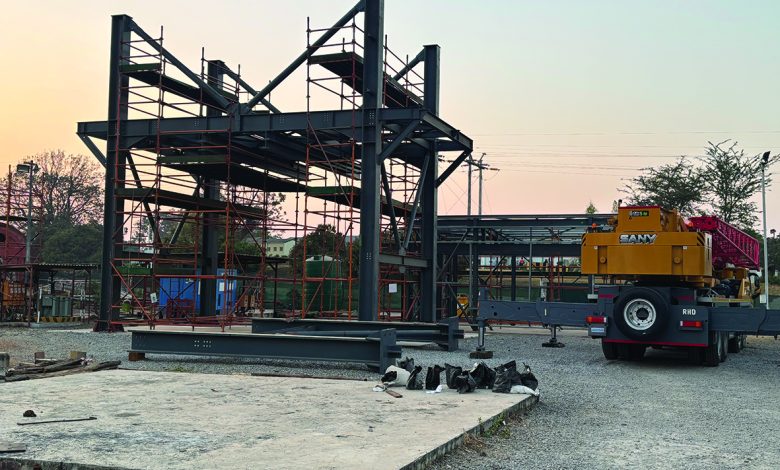
Cementation Africa is leveraging decades of expertise in shaft sinking and underground mining at Mopani Copper Mines’ Mindola shaft in Zambia, paving the way to extend the life of the Nkana mine in Kitwe while improving operational efficiencies.
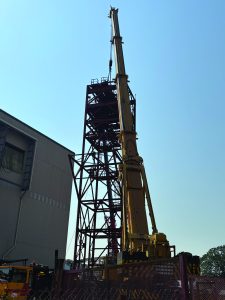
The scope of work includes the construction and erection of permanent headgear, rope-up and commissioning of winders, as well as detailed 3D scanning of the shaft to assess alignment corrections and structural reinforcement. These upgrades are aimed at ensuring safe and efficient conveyance operations. The project also incorporates the installation and commissioning of an overland conveyor system.
According to Ben Adendorff, Cementation Africa’s In-Country Executive for Zambia, the primary focus is on preparing the Mindola shaft for production by slipping and equipping the remaining 500 metres.
“To determine the exact degree of misalignment, Cementation Africa will complete a 3D scan of the complete shaft,” Adendorff says.
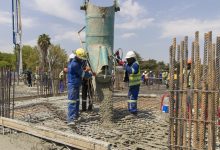
While another contractor previously raises bored the shaft, Cementation Africa has an established track record in Zambia, having successfully completed the sinking and equipping of Mopani’s Synclinorium and Mufulira Henderson shafts more than a decade ago. The 1,280 m Synclinorium shaft, with a 7 m diameter, was sunk between 2011 and 2014 and later equipped for commissioning and handover in 2016. The 1,580 m Mufulira Henderson shaft, with a 6 m diameter, was commissioned in June 2020.
“Our current work at Mindola includes the removal of the sinking headgear and winders, and the installation of a new permanent headgear, after which we can rope-up and commission the new winders,” he explains. “This will allow us to scan the shaft from top to bottom with specialised equipment, including the length of shaft already equipped above a depth of approximately 1,000 m.”
This process will verify the alignment and integrity of existing steel members that guide conveyances down the shaft, while also identifying and addressing any structural issues. Below the 1,000 m mark, the bottom 500 m of the shaft barrel will be slipped and lined to ensure a true vertical alignment for safe conveyance travel.
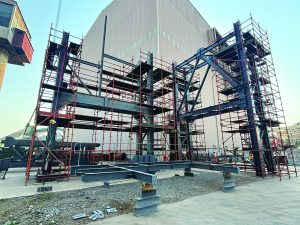
“We will then proceed with the equipping of the shaft and construction of the loading box steelwork at the shaft bottom,” he adds.
The company’s legacy in some of Africa’s deepest and most technically challenging shaft-sinking projects continues to underpin its reputation in Zambia, according to Hercilus Harmse, Engineering Services Executive at Cementation Africa. He highlights major regional projects such as the 1,200 m shaft at Palabora Mining Company, which reached final depth in 2024, and the 2,750 m ventilation shaft at South Deep.
“Many of our projects are conducted in environments where there are poor ground conditions or where extensive de-stressing of rock is required,” Harmse says. “We bring this experience into our designs and execution, ensuring that we can apply innovative solutions using our fleet of specialised equipment for rigging, winding and shaft sinking.”
Safety remains a cornerstone of Cementation Africa’s operations both in Zambia and globally, emphasises Graham Chamberlain, New Business Director. Over the past 12 years of shaft sinking and mine development, the company has achieved more than eight million fatality-free shifts.
“This is the result of consciously building a safety culture on every site and prioritising safety in all our planning and design work, using industry experience to learn from every incident,” Chamberlain says. “Particularly with equipment that is critical to safe operations, we develop and apply duplicate systems so there is always a backup. With winders, for instance, we ensure that an electronic system is duplicated by a mechanical system in case of failure.”
Beyond its technical contributions, Cementation Africa has also made a meaningful social impact in Zambia. According to Adendorff, the company has supported community development initiatives, including the construction of a school for the deaf in 2016, which now serves over 100 children, as well as an orphanage feeding scheme.
“Our history in Zambia has also made us an employer of choice, as everyone knows our value system and the respect with which we treat our employees,” he concludes.