
Weba Chute Systems tackles the unseen constraints holding back plant performance
Why overlooked transfer points are often the real cause of underperforming mining plants
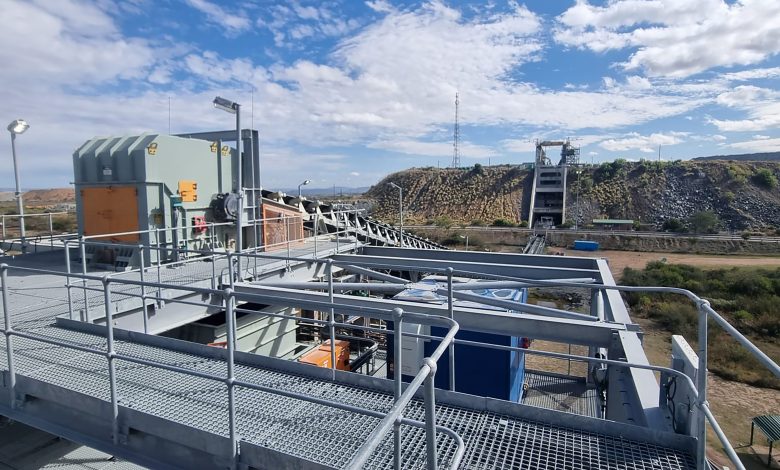
Across the global mining industry, a clear pattern is emerging. Original equipment manufacturers, engineering, procurement and construction management contractors, and mine operators are increasingly turning to Weba Chute Systems to solve persistent plant performance issues that conventional fixes fail to address.
In many cases, the problem is not the crushers, screens, or feeders themselves, but what happens in between them.
As plants are upgraded or expanded, new equipment is typically well specified and engineered. However, the transfer chutes linking these units are often underestimated or treated as secondary components. When material transfer is poorly controlled, it can quickly undermine the performance of even the most advanced processing equipment.
Transfer points as the hidden bottleneck

Transfer points frequently become the unseen bottlenecks within a processing circuit. Poorly designed or outdated chutes can result in uncontrolled material velocity, excessive impact forces, spillage, uneven feed distribution, and accelerated wear. Over time, these issues lead to premature liner failure, increased downtime, and a measurable loss in overall plant efficiency.
According to Mark Baller, Managing Director of Weba Chute Systems, the company is often brought in after multiple attempts to resolve performance issues have failed.
“In many cases, the mine or project team initially focuses on the mechanical or structural performance of the upstream equipment,” Baller explains. “However, when the problem persists closer inspection often reveals that the root cause lies in the uncontrolled manner in which the material is being transferred from one point to another.”
He adds that even small variations in flow trajectory, velocity or impact angle can significantly affect how downstream equipment performs, influencing wear rates, vibration behaviour, and throughput stability.
Engineering insight built on experience
With one of the largest global reference bases of custom-engineered chute systems, Weba Chute Systems brings extensive experience across commodities including iron ore, coal, manganese, platinum, gold, and copper. The company’s expertise spans virtually every stage of the mineral processing flow sheet.
This depth of experience allows Weba’s engineers to rapidly identify where transfer conditions are contributing to operational problems. Each investigation typically starts with a detailed site assessment and comprehensive data collection, followed by discrete element modelling simulations to replicate real operating conditions.
“Through these simulations,” Baller explains, “our team can visualise material trajectories, particle interactions, and wear patterns to pinpoint exactly where problems occur – whether this involves excessive material build-up, misalignment, or uncontrolled impact. This scientific approach ensures that any redesign is not based on trial and error but on quantifiable evidence.”
Proven results from real operations
In one case, an EPCM contractor responsible for upgrading a manganese screening plant approached Weba Chute Systems after newly installed screens began experiencing frequent pegging and uneven feed distribution.
DEM analysis revealed that the existing chute design was concentrating material into a narrow stream, overloading one side of the screen, and causing vibration imbalances.
By redesigning the chute with optimised internal geometry to control material trajectory and evenly distribute the feed, the Weba Chute Systems team eliminated the pegging issue. Screen performance was restored, product grading improved and maintenance requirements were significantly reduced.
In another example, a platinum concentrator faced repeated blockages and severe liner wear at a transfer point feeding its secondary mill. Although the mill itself was mechanically sound, DEM simulation showed that material was entering the feed chute at excessive velocity, causing high impact wear and uneven distribution.
A replacement chute incorporating energy absorption and flow control features resulted in more than a threefold increase in liner life and a substantial reduction in unplanned downtime.
A systems-based approach to plant optimisation
Baller emphasises that Weba Chute Systems does not treat transfer points as isolated components.
“We seldom treat a transfer point as an isolated component,” he says. “Each chute interacts with the process upstream and downstream. Our objective is to stabilise the entire system, ensuring that equipment such as screens, feeders and mills is protected and operate within their design parameters.”
This holistic approach has proven particularly valuable for EPCM contractors tasked with meeting plant performance guarantees. Early engagement with Weba Chute Systems during design or optimisation phases helps reduce commissioning risk, enable smoother start-ups, and ensure plants achieve stable performance from day one.
Reliable solutions across the flow sheet
From primary crushing and screening through to secondary milling, flotation and concentrate handling, Weba Chute Systems designs solutions tailored to each application. Its chute systems have become industry benchmarks for controlled material flow, reduced dust generation, extended wear life, and higher plant availability.
“Every mine is under pressure to maximise throughput and minimise downtime, and our role is to ensure that material transfer, a seemingly minor aspect of the plant – does not become the limiting factor in achieving those goals,” Baller concludes.