
Flying African mining to new heights
Despite regulatory hurdles in some countries, drone adoption is adding a new dimension to how mining is conducted across Africa.
By Jimmy Swira
There is a perception – amongst some suppliers of products and services – that mining companies are not the most dynamic of clients when it comes to embracing new technologies that can add value to their operations. Arguably, this could be the case with other products, but not in the usage of unmanned aerial vehicles (UAVs), commonly known as drones.
Unprecedented Growth
Notably, in the area of UAVs, there has been unprecedented growth in their usage in the past decade in Africa. UAVs are being deployed across the entire mining cycle – from exploration, daily operations, to mine closure and rehabilitation.

This trend is more or less similar to other mining jurisdictions globally. However, on the continent, mines are using drones to address unique challenges in their respective operations. And strong indications are that more is yet to come.
Solution for Unique Challenges
Based on recent activities on the continent, a vivid picture of the various applications of UAVs throughout the mining cycle emerges – conspicuously in the following areas:
i. Mapping and Surveying
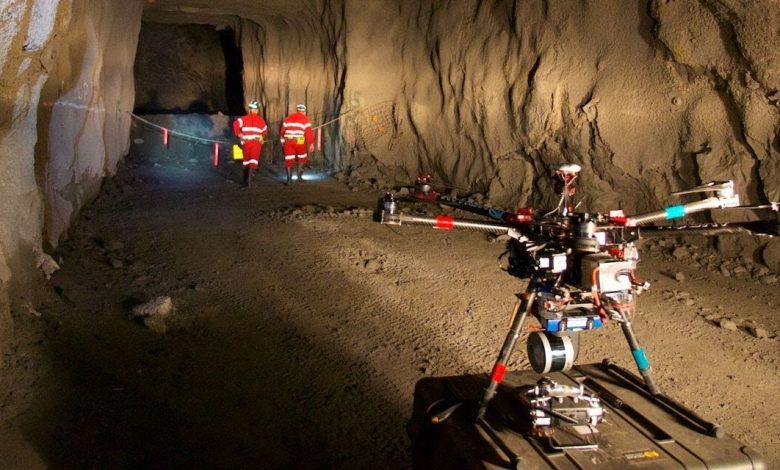
Specialised UAVs equipped with LiDAR and high-resolution cameras are able to produce accurate 2D and 3D maps and generate models for surface and underground operations. This eliminates the need to send personnel to manually inspect areas that would otherwise expose them to hazards.
In South Africa, Palabora Copper Mine uses UAVs for LiDAR scans of underground voids. This enables surveyors to work from a safe distance of up to 100 metres.
At Exxaro’s Grootegeluk mine, Rocketmine uses UAVs for surveying and mapping. This ensures that surveyors can avoid hazardous areas, significantly increase data accuracy, and improve turnaround time by providing real-time data on a shift-by-shift basis.
ii. Volumetric Measurements
By conducting frequent aerial surveys, UAVs can rapidly and accurately calculate the volume of stockpiles and help determine the movement of material.
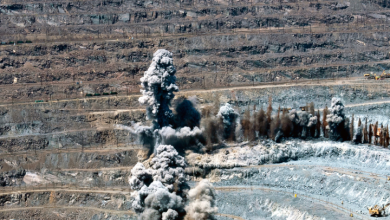
Exxaro Resources Group, in partnership with Johannesburg UAV service provider Rocketmine, uses UAVs for a wide range of activities at Grootegeluk mine – among them are stockpile inspection and blast monitoring.
Rocketmine UAVs monitor stockpile movement at Rössing Uranium mine in Namibia, providing accurate data.
iii. Safety and Asset Inspections
UAVs perform a range of tasks, such as visual inspections of machinery. The data collected helps in instituting suitable maintenance programmes. In the end, this prevents failure and enhances asset availability.
In addition, UAVs are used in the inspection of infrastructure like haul roads and hazardous areas such as tailings dams. This helps mining companies take suitable measures to mitigate accidents.
In South Africa, Kumba Iron Ore uses UAVs to survey drilling sites and monitor overall site conditions.
iv. Security and Anti-Illegal Mining
The scourge of illegal mining is becoming a challenge for gold mining companies and authorities on the continent. Illegal miners, who are mostly armed and will stop at nothing to get their way, are encroaching on designated areas, vandalising infrastructure, accessing minerals, and threatening the lives of employees and surrounding communities.
A case in point is Ghana, where the Minerals Commission has implemented a system that uses 28 UAVs and an AI-powered control room to monitor illegal mining hotspots.
v. Environmental Monitoring
The use of UAVs in environmental monitoring has been phenomenal.
UAVs gather data to help monitor the impact of mining activities on the environment. These include – but may not be confined to – assessing reclamation efforts, monitoring land cover, and tracking water quality and sediment flow.
Key Benefits
Through the abovementioned, among some of the applications, UAVs bring benefits to mining operations once regarded as unattainable – mostly in the following ways:
1. Improved Safety
Safety is, without doubt, a major driver of adoption through removing employees from some of the hazardous and dangerous tasks on mine sites.
2. Increased Efficiency and Cost Savings
Efficiency and cost savings are the buzzwords in mining operations. The use of UAVs plays a part in making this a reality.
Manual or helicopter-based surveying is time-consuming and costly. In contrast, UAVs cut down the time and expenses usually associated with these methods. Eventually, this leads to operational improvements and a reduction in costly downtime.
3. Confidence in Data Accuracy
With traditional methods, there are always questions about the accuracy of data, as an element of human error could be factored in. There is always a possibility that conditions under which the data was collected have changed.
Instead, by providing more accurate and frequent data, UAVs give more confidence and lend more credibility to the data. This allows for better decision-making in the respective applications where they are used.
Data provided by UAVs is securely stored in cloud-based platforms. This makes it easy to process and share.
There is no question that the growth niche of UAVs in African mining is unprecedented – bringing about many benefits – and set to add more to the range.
There is a blot, though – if you ask any UAV operator, getting the necessary paperwork to operate can be frustrating – sometimes, unnecessarily so.
The Licensing Barrier
While a free-for-all scenario is not good for operations, there is a perception that strict UAV licensing regulations are a barrier that prevents industry access and involvement in activities that grow economies.
For instance, one UAV solutions provider at a recent exhibition lamented the strict UAV licensing regulations in South Africa, where non-compliance can lead to fines and legal issues.
For one thing, this disconnect between innovation and regulation is worrying: it highlights the need for a more enabling environment that balances safety, accountability, and access.
Once this barrier is removed, there is no question that UAV adoption can continue flying African mining to new heights – supporting growth and transformation.