
Modern filtration technology boosts zinc recovery at Nyrstar Hobart
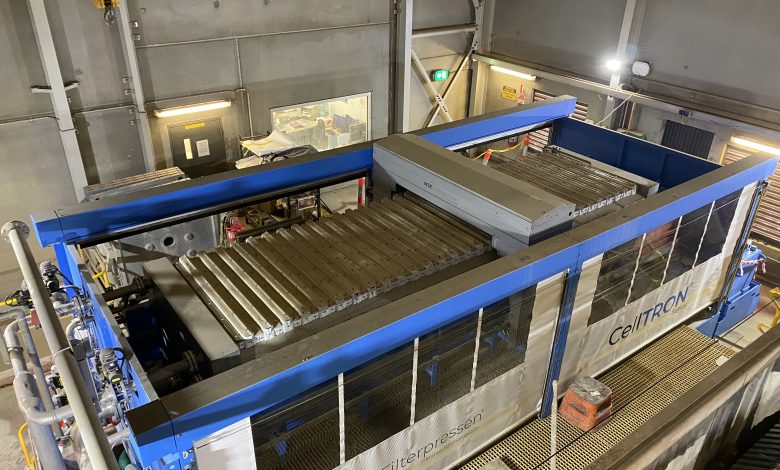
To strengthen its production capabilities and optimize resource efficiency, Nyrstar has implemented a significant technical enhancement at its Hobart site in Tasmania. A newly installed membrane filter press now supports the solid-liquid separation stage within the established Roast-Leach-Electrowinning (RLE) zinc production process — a critical step that directly affects yield, process stability, and occupational safety.

Solid-liquid separation in the RLE process
The RLE process is a standard hydrometallurgical method in zinc production. Following roasting, the zinc concentrate undergoes leaching with sulfuric acid, producing a slurry that contains both dissolved zinc and solid residues. Efficient separation of these components is essential: inadequate filtration can reduce metal recovery, compromise product quality, and introduce operational inefficiencies further downstream.
Recognizing these challenges, Nyrstar sought to improve the consistency and efficiency of this process step, particularly in light of planned capacity increases at the Hobart facility. A robust and high-performing filtration system was required—one that could reliably manage larger throughputs while maintaining low residual moisture and high filtrate clarity.
Customized filtration solution from Germany
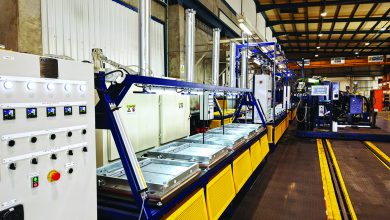
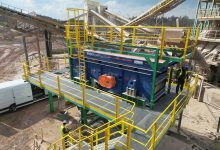
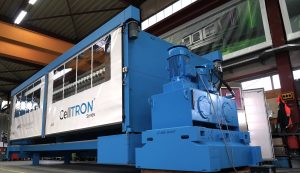
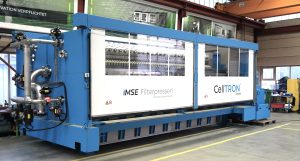
To meet these demanding process conditions, Nyrstar partnered with the German manufacturer MSE Filterpressen GmbH, a company specialized in industrial filter press systems. The selected solution: a fully automated membrane filter press engineered for chemical resistance, mechanical durability, and precise control across all stages of operation.
At the heart of the system are membrane filter plates, which first separate the slurry solids under mechanical pressure. After the initial filtration phase, the membranes are hydraulically inflated using water, compressing the filter cake further to significantly reduce its residual moisture. This dual-phase approach ensures high dewatering efficiency and improves the manageability of the resulting solids.

Materials and configuration tailored to site demands
Given the aggressive nature of the process environment especially the presence of sulfuric acid the system was built with PVDF (polyvinylidene fluoride) membranes due to their excellent chemical resistance. The press frame and contact surfaces are clad with duplex stainless steel, offering added protection and longevity under corrosive conditions.
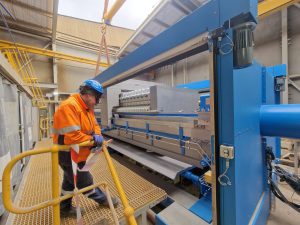
To simplify transport and installation across the more than 16,000-kilometer supply chain, the filter press was designed as a modular unit, broken down into several transportable sections. This not only facilitated logistics but also ensured efficient assembly despite limited available space at the Hobart site.
Advanced automation and process safety
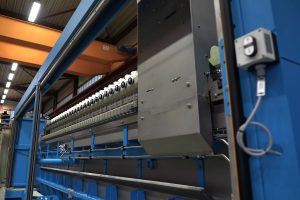
The entire filtration sequence is fully automated, including slurry injection, pressure management, plate movement, cake discharge, and filter cloth washing. Operator intervention is minimized, enhancing both process consistency and plant safety.
Integrated safety functions and intelligent sensors provide real-time feedback and protection, especially under the system’s high operating pressures of up to 15 bar. Uniform cycle times and automated control contribute to a steady production rhythm, reducing the risk of bottlenecks or unplanned downtime.
Worker protection and environmental efficiency
The press system features a fully enclosed design that isolates acidic slurries and minimizes vapor exposure. Automated cake handling further reduces the need for direct operator contact, aligning with Nyrstar’s strict occupational health and safety standards.
In addition to enhancing workplace safety, the reduced moisture content of the final filter cake supports more efficient downstream logistics—less energy is needed for drying or disposal, and material handling becomes safer and cleaner. These improvements also reduce the environmental footprint of the operation, contributing to more sustainable metal production.
Seamless project coordination
The 40-tonne filtration unit was shipped in stages from MSE’s manufacturing site in Germany to Tasmania via sea and land freight. Installation and commissioning were executed by MSE’s experienced technical team, in close coordination with the Nyrstar project management group. Despite tight spatial constraints and time-sensitive conditions, the system was installed and brought online according to schedule.
Strategic impact and industry relevance
This project illustrates how targeted investments in process optimization can yield tangible operational benefits. By deploying a filtration system precisely tailored to the RLE process, Nyrstar has improved metal recovery rates, increased plant stability, and reinforced worker safety—all while supporting long- term sustainability goals.
At the same time, the success of this project reflects a broader industry trend: growing demand for automation-ready, high-performance separation technology in the field of hydrometallurgy. With increasing pressure on producers to operate more efficiently and responsibly, advanced filtration systems like the one installed at Nyrstar Hobart are becoming key enablers of future-proof operations.